About
I've moved around a lot.I think that is why I notice how people and places work.
Introduction
I'm Raj. I was born in Hyderabad and studied across Hyderabad, Chennai, Kolkata, Gujarat, Rajasthan, Bikaner and Bangalore. Moving schools was not always planned, but it made me observant. Every place had a different rhythm, set of rules, and way of making you find your footing.
I found computers and STEM robotics in class six, kept following that curiosity, and eventually arrived at Kalvium to study Computer Science, AI and Financial Technology. Along the way, building things became the way I made sense of the world: websites, systems, images, machines, and ideas that are still becoming clear.
I build software, AI systems and things I wish existed.
What I build
I move between four kinds of work: products I build end to end, a studio I run for other people's businesses (Kaisei), small interface experiments that don't need to justify themselves, and code released because someone else might find it useful.
The developer in me is useful. It is not the whole story. I am also interested in how things feel, how people move through a place, why some objects age well, and what makes an idea worth carrying into the real world. I care about technology, creativity and entrepreneurship, and I like taking an idea from a random thought to something people can actually use.
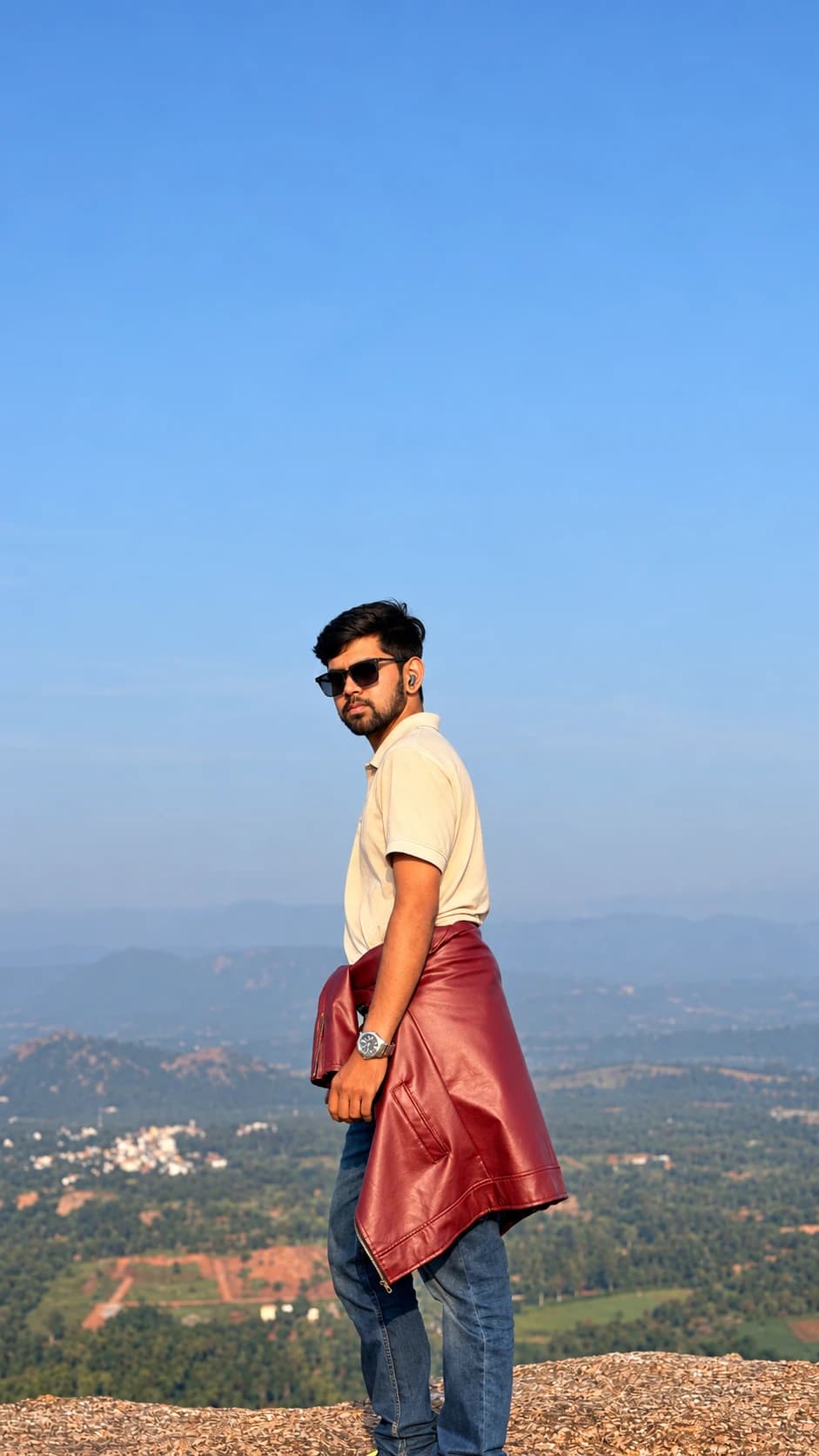
Background
2007-2015
Hyderabad to a moving map
Born in Hyderabad, early school years at Meridian School, then short chapters in Chennai and Kolkata, then Gujarat and Rajasthan. Repeating a class after a school move taught me early that progress is not always a straight line.
2015-2019
The first pull toward technology
In Bikaner, at Delhi Public School, a computer teacher and a STEM robotics teacher made technology something you could take apart and build with.
2019-2023
Finding a home base
Completed schooling through class ten at Unicent School, went through Ignite for pre-university coaching, learned that proximity does not always mean fit, and completed class twelve at Sri Aadya P.U.
2023-now
A pause, then Bangalore
Four months at home researching what I actually wanted to learn, then Kalvium, studying Computer Science, AI and Financial Technology, while building Kaisei and a life that keeps crossing between digital work and physical interests.
Experience
2024
Started building random web projects
Fell in love with shipping.
2024-now
Founder, Kaisei
Building a Japanese-inspired digital studio around websites, web management and app development. Deliberately small in scope and high in ownership: understand the problem, make the direction clear, then carry it through.
2025
Co-founded Spotameet
Learned a lot about real-world building.
2026
Building Voino
Exploring AI, voice interfaces and what comes next.
Ongoing
Builder / visual researcher
Using photography, motorcycles and robotics to stay close to materials, feedback and physical constraints that digital work can hide.
Education
Kalvium, in partnership with Alliance University: BTech in Computer Science, Artificial Intelligence and Financial Technology. July 2025 to February 2029.
Outside code
Motorcycles, robotics and photography. I like things that have to work in the physical world, and small businesses run by people, not committees: cafes, studios, workshops, local brands. Music, good food, new places.
Note
I'd rather publish one specific, verified sentence from someone I've worked with than five vague compliments. There are no invented testimonials on this site.
Studio
Websites and small digital systems for founders.
Kaisei is a small design and development studio. We build for founders, local businesses and small teams.
Websites
Websites that explain what you do and make the next step obvious.
- Who it is for
- Founders, studios and local businesses that need a sharper public presence.
- What you get
- Strategy, content structure, visual direction, responsive design, development and launch.
Product interfaces
Clear interfaces for products people need to understand quickly.
- Who it is for
- Early-stage teams turning an idea into a usable product.
- What you get
- User flows, wireframes, interface design, prototypes and front-end implementation.
Digital systems
Small, reliable systems that remove repetitive work.
- Who it is for
- Teams managing information, workflows or customer operations by hand.
- What you get
- Lightweight tools, dashboards, automations and integrations built around how your team already works.
Research
Learn the business, the users and what the site needs to do.
Design
Structure and visual language, reviewed at each stage.
Build
Develop, test across devices, and refine until it is ready to ship.
Maintain
Keep it fast, secure and current after launch.
What I'm building
What I'm building.
The companies and products I run, co-found or lead the engineering for.
Kaisei Studio
Founder · Digital design and development
Websites and digital systems for small businesses.
The studio I founded and run. Websites and digital systems for founders and service businesses.
Read about it →Two startups
Co-founder · Product and company building
Building early products with small teams.
Spotameet, a platform connecting people, events and spaces, is one of them.
Read about it →Three startups
Tech lead · Engineering and architecture
Leading the engineering.
What I hold to.
Written down so I can check myself against them. They change when I do.
Build before you overthink.
Ideas are cheap. Execution teaches.
Learn by making.
The fastest way to learn is to build.
Small experiments compound.
You don't need a perfect plan.
Don't build what nobody needs.
Solving real problems always wins.
Own your distribution.
Build an audience, not just a product.
Make things worth remembering.
Put care into what you create.
Stay curious.
There's always more to learn.
Currentlyupdated 2026-10-08
- Building
Voino. Voice intelligence and visual board building.
Kaisei, my studio. Websites, web management and apps.
Three clear offers for Kaisei, and an easier way for clients to get started.
- Exploring
AI agents and model harnesses.
New product ideas, and ways to make software more human.
Small interface experiments: colour-reactive grids, IDE-style UIs, pages built from empty space.
Robotics and machines, and interfaces that sense the world around them.
- Learning
Distributed systems, and how to build and scale products.
AI systems and better design.
Financial UX: the gap between a number and the decision it should help you make.
- Reading
The Pragmatic Programmer
Poor Charlie's Almanack
The Mom Test
On Writing
- Thinking about
What makes a local business feel trustworthy before anyone has spoken to it.
What software could learn from how an old motorcycle gives feedback: sound, heat, resistance, movement.
Photography
A moment before it disappears.
Photography is how I slow down and notice detail.
See the photographs →